Every now and then, we come across a finance book that attempts to impress us with complex explanations or dramatic scenes. But, Bulls, Bears and Pigs takes a different approach. It is a straightforward story told by someone who lived through major events in both his professional and personal life.
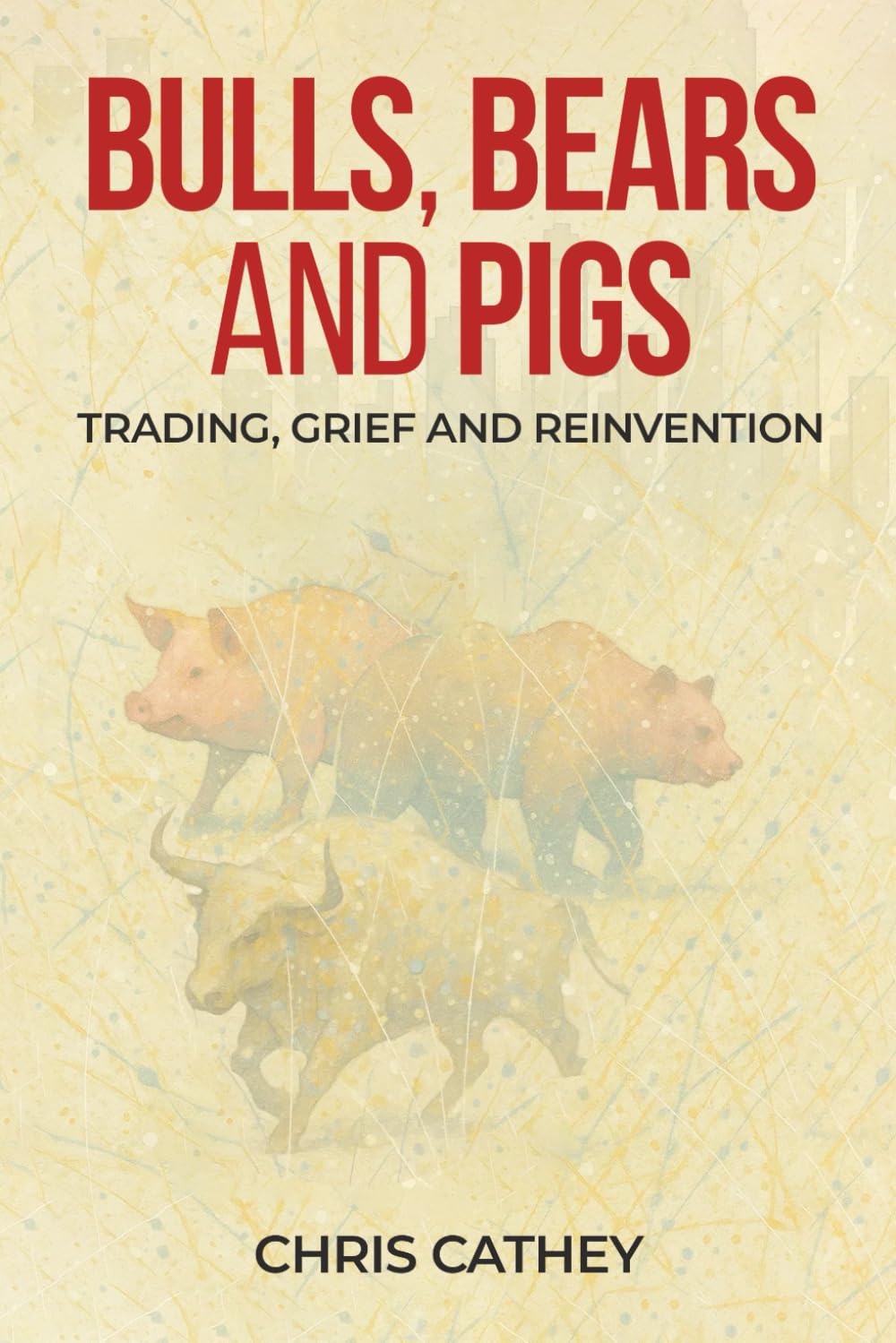
Chris Cathey does not dress up his experiences, as the book begins with his childhood in Newcastle. He explains the atmosphere of a working class neighbourhood and the influence of family and school. These early chapters give the reader enough detail to understand where he comes from without getting lost in side stories. The transition from that environment to Cambridge and then Goldman Sachs is noticeable. Cathey does not hide the discomfort he felt at first, but he also does not dwell on it. Instead, he shows how he adapted.
His descriptions of the trading floor before the digital age are one of the book’s strongest elements. Readers who have never set foot in a financial institution will learn what the job actually involves. It was fast, loud, and entirely dependent on clear communication. Cathey explains how orders were written by hand, how traders relied on memory and judgment, and how mistakes had to be owned immediately. These details give the book a grounded view of the industry.
As the book moves into Cathey’s personal life, the tone softens. He writes about meeting his wife, Claire, and building a relationship based on trust and shared humour. The simplicity of these chapters makes them easy to connect with. When Claire is diagnosed with breast cancer, the shift is sharp but handled with care. Cathey does not add drama. He writes about the fear and uncertainty in direct and honest terms.
The chapters that follow her death are some of the most moving in the book. Cathey suddenly finds himself responsible for raising four children on his own. He writes about the practical challenges and the emotional strain. What stands out is his willingness to show his vulnerability. He does not pretend that he handled every moment perfectly. Instead, he shows the real work of rebuilding a life that has been fundamentally changed.
Throughout the book, Cathey revisits the concept of responsibility. On the trading floor, responsibility meant managing risk and protecting the firm. In his personal life, responsibility meant caring for his children and finding a way to move forward. These two forms of responsibility appear to be distinct, yet the book demonstrates their connection. Both require discipline, focus, and honesty.
The writing style is accessible, making the book suitable for readers with no background in finance. Cathey explains the trading environment without using technical terms. He also avoids presenting himself as an expert in life. Instead, he presents events as they happened. That approach gives the book a quiet strength.
One of the most effective aspects of the book is the balance between the external world and the internal one. Cathey demonstrates what it means to succeed in a demanding career while also illustrating how quickly that career can lose importance when personal tragedy strikes. He does not dismiss his years in finance. He appreciates the opportunities they gave him. But he also understands that life extends far beyond a job.
Bulls, Bears and Pigs is a powerful reminder that behind every career story is a human story. The book is not loud or dramatic. It is steady, honest, and deeply human. Those seeking a realistic perspective on finance or a thoughtful account of personal resilience will find value in every chapter, and they will learn a great deal from this memoir.
Read this book now: https://www.amazon.com/dp/197122815X.